How can we provide a simulated pharmacy experience for our 1st year students to achieve more equitable outcomes on their Top 100 exam?

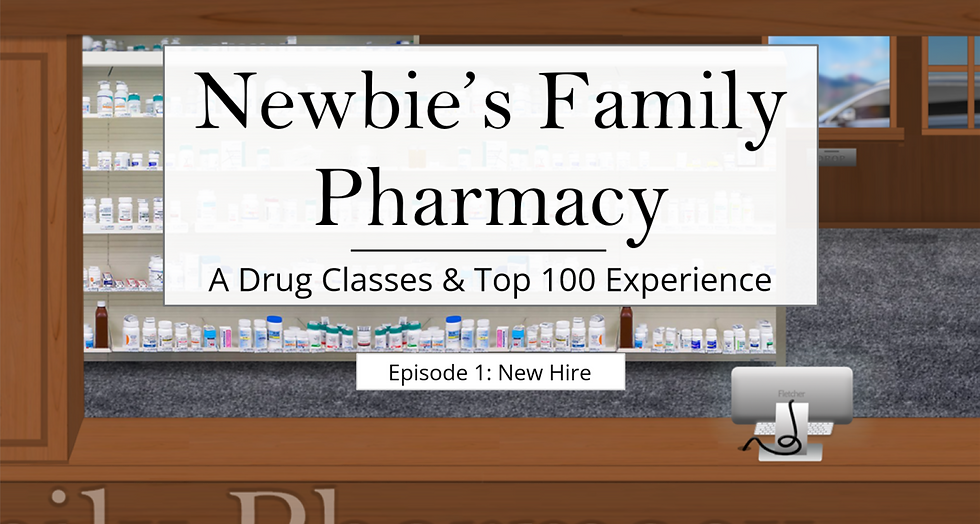
The "Newbie's Family Pharmacy" experience is a longitudinal experienced designed to, in part, allow students pharmacists with no pharmacy work experience to gain experience in a simulated pharmacy workflow. It provides student pharmacists with continued exposure to the responsibilities of a pharmacist throughout the 9-module experience and challenges students to apply their knowledge to various scenarios and activities.
-
Audience: First year student pharmacists
-
Responsibilities: Content mapping, storyboarding, graphic design,
-
Tools Used: Articulate Storyline 360, SCORM, Adobe Photoshop, Pixabay, MS Excel
The Director of Pharmacy Practice Skills (PPS) oversees the Top 100 exam, a high-stakes exam that students must pass in order matriculate. The exam covers critical facts about drugs that students must know in order to practice safely. In the year prior, the number of students requiring remediation for the exam increased significantly. I worked with students and faculty stakeholders to identify the glaring need for repeated exposure, especially for those without pharmacy experience.
Solution
I proposed a longitudinal, simulation-based learning experience to provide student pharmacists continual exposure to the drugs they will be responsible for on their Top 100 exam. The context around the simulation was a retail pharmacy, the most commonly identified setting for student pharmacy experience. This provided opportunities to discuss drugs as they relate to pharmacy workflow, skills, drug interactions, law, and safe order verification (among others).
Process
Process
The ADDIE model was utilized to guide the process for developing the learning experience. Merrill's Principles of Instruction was the guiding framework for structuring the module with an emphasis on guiding students through authentic tasks. A content map for each module was developed to identify which drugs would be utilized in each module and when they would be strategically reinforced in the series. Drugs and drug classes were mapped to skills that could be highlighted in each module to reinforce concepts and create meaningful experiences (eg, diabetes drugs were mapped to the blood glucose meter use simulation).
I utilized Adobe Photoshop to develop an authentic simulated pharmacy environment along with realistic, action-oriented tasks like prescription verification utilizing a mock prescription profile tool. These were integrated into Articulate Storyline. In order to boost engagement longitudinally, a short narrative was developed to promote intrinsic interest in each module.
The ADDIE model was utilized to guide the process for developing the learning experience. Merrill's Principles of Instruction was the guiding framework for structuring the module with an emphasis on guiding students through authentic tasks. A content map for each module was developed to identify which drugs would be utilized in each module and when they would be strategically reinforced in the series. Drugs and drug classes were mapped to skills that could be highlighted in each module to reinforce concepts and create meaningful experiences (eg, diabetes drugs were mapped to the blood glucose meter use simulation).
I utilized Adobe Photoshop to develop an authentic simulated pharmacy environment along with realistic, action-oriented tasks like prescription verification utilizing a mock prescription profile tool. These were integrated into Articulate Storyline. In order to boost engagement longitudinally, a short narrative was developed to promote intrinsic interest in each module.
Content Map
A content map was required for this project to ensure that the hundreds of critical concepts about the selected drug classes would be covered and strategically reiterated within the module and throughout the course of the longitudinal experience.


Storyboarding
Due to the volume of information in each module, a storyboard was created using scenes that were developed for the content maps above. Each scene was designed to allow students to introduce material, reiterate material, or allow students to apply material they had learned to a realistic scenario. Scenes were sequenced to allow for maximal engagement and to delicately balance passive learning with activities to apply learning.
Once the initial module was created, Articulate Storyline 360s 'Story View' was used as a mock storyboard to improve sequencing for subsequent modules. Blank slides were used to when theme elements or repeated practice were needed, but not yet developed.

Results
The implementation of an engaging simulated eLearning experience was well received by the first year students. As expected, the students spent, on average, about 20 to 30 minutes to complete each module. Despite the length, the user-rated experience was consistently between 4.4 and 4.6 stars (out of 5) across an eight month time span. All-in-all, 97% of students strongly agreed or agreed that they were looking forward to a similar experience in their second professional year. A 100% first-time pass rate was achieved on the high-stakes Top 100 exam.
Takeaway
Utilization of engaging teaching strategies to introduce new experiences to students that evolve from module-to-module is an effective approach to maintain learner engagement. Promoting intrinsic motivation through thematic and authentic experience was desirable for the learners and promoted interaction with the experience. While studying plays a vital role in ensuring success on critical high-stakes exam, effective longitudinal reiteration of material and creating meaningful experience aids in the transfer of knowledge to long-term memory.